.png)
Good morning. We’re covering Russia’s nationalist holiday, Hong Kong’s new leader and a Taliban decree targeting women.

What will May 9 bring?
Today is Russia’s Victory Day, a militaristic holiday that commemorates the Soviet Union’s defeat of the Nazis in World War II. Under President Vladimir Putin, the holiday has come to celebrate modern Russian military might.
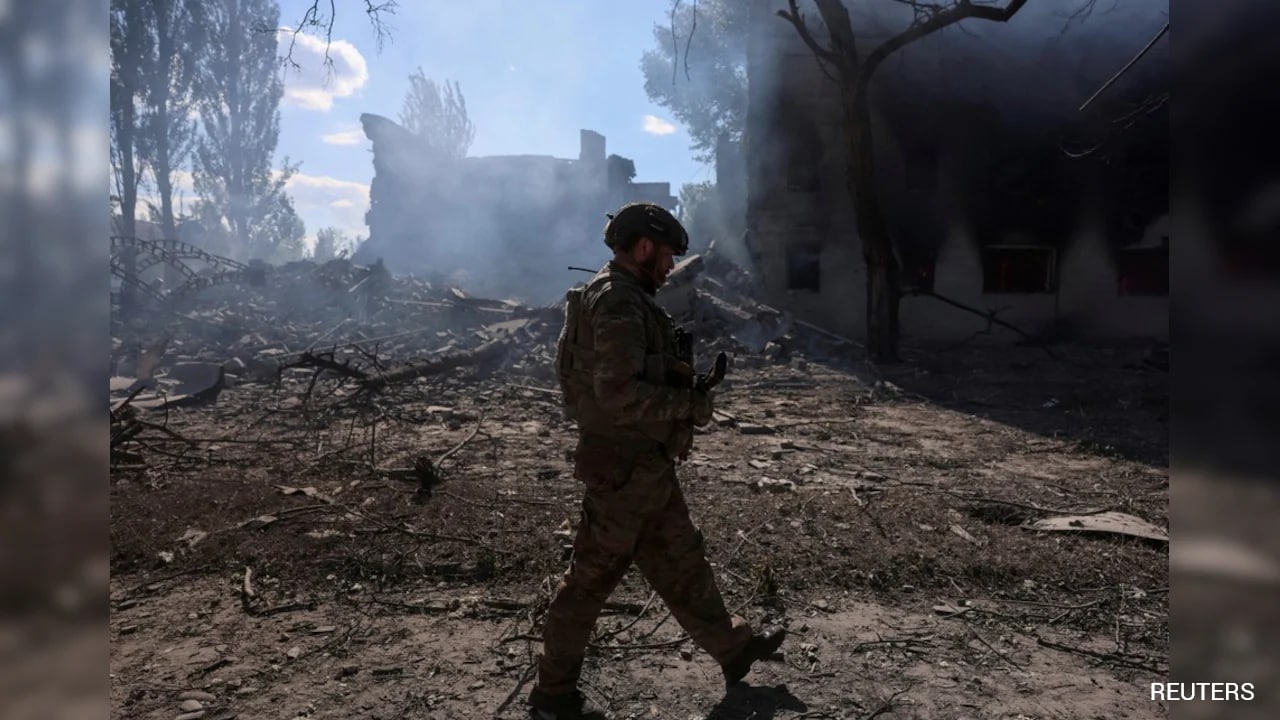
Over the weekend, Moscow’s forces renewed their assault in eastern Ukraine in a scramble to show progress before the holiday. On Sunday, Ukrainian officials said a Russian airstrike leveled a school in the region that was being used as a shelter. Dozens of civilians may have died.
In congratulatory messages on Sunday, Putin praised the leaders of the Donetsk and Luhansk people’s republics — two Russia-backed breakaway territories in the east — for their role in what he described as a fight against “Nazi filth.”
Both sides are focusing on one village at a time. Ukrainian forces, mounting a highly mobile defense, took back territory around Kharkiv, once the country’s second-largest city.
Mariupol: All women, children and elderly people were evacuated from the steel plant. In a virtual news conference from a bunker beneath the plant, the soldiers there vowed to fight on. “We here are basically dead men,” one officer said. “Most of us know this. This is why we fight.”
Analysis: Russia miscalculated how much support it would get from Ukrainians. And the C.I.A. director said the war is in a dangerous phase because Putin “thinks he cannot afford to lose.”
Other updates:
Jill Biden made an unannounced visit to Ukraine, the latest show of U.S. support.
Justin Trudeau, the prime minister of Canada, also made an unannounced visit and reopened his country’s embassy in Kyiv.
The leaders of the Group of 7 pledged to cut off the purchase of Russian oil..
Beijing’s man will lead Hong Kong
John Lee, a former security chief, was chosen as the city’s next leader in an uncontested race controlled by Beijing.
Lee, the top architect of the crackdown on Hong Kong’s antigovernment protests in 2019, plans to push through laws on treason, secession, sedition and subversion, and to root out critics in the civil service. He inherits a city that has been tamed and cowed: Sweeping national security laws imposed two years ago have quashed dissent, gutted the free press and put critics behind bars or sent them into exile.
He will also face a city embattled by some of the world’s toughest pandemic restrictions. The economy is shrinking, unemployment is rising and growing numbers of people are leaving the city, imperiling its status as a global financial center.
Context: Beijing has always let it be known who it wants in the top job, though more subtly in the past. This time, China removed any veneer of competition and effectively neutered the pro-democracy camp with new electoral rules and the national security law.
Quotable: “Even in Iran, there is more of a contest for the head of government,” one expert said.
New restrictions on Afghan women
The Taliban decreed on Saturday that women should cover themselves from head to toe in public. The move expands a series of onerous Taliban restrictions on women that dictate nearly every aspect of public life, including their employment, education, travel and deportment.
A burqa is the preferred garment, but the Ministry for the Promotion of Virtue and Prevention of Vice — which replaced the previous government’s Ministry of Women’s Affairs — did not mandate burqas as long as women otherwise cover themselves with a hijab.
Failure to do so could result in a jail sentence for the male head of the woman’s family. The relatively few women still permitted to hold jobs could be fired if they do not comply with the decree.
History: The Taliban required the burqa, which leaves only a woman’s hands and feet visible and includes a stitched facial netting for vision, when it ruled most of Afghanistan from 1996 to 2001.
Eid: For many Afghans, the end of Ramadan showed the dissonance between the promise of peace many had imagined and the realities of the end of the war.
THE LATEST NEWS
Asia
Sri Lanka’s strongman president declared a state of emergency, his second in recent weeks, amid protests over the deepening economic crisis — and his leadership.
North Korea tested a submarine-launched missile on Saturday, which could extend the range of its nuclear arsenal.
The U.S. is pushing Taiwan to order American-made weapons for asymmetric warfare, which would help its small military repel a seaborne invasion by China.
Misinformation is spreading in the Philippines with the approach of the presidential election.
World News
In a seismic shift driven by Brexit, the nationalist party Sinn Fein won the most seats in Northern Ireland’s government.
At least 22 people were killed in Havana after a powerful explosion destroyed parts of a luxury hotel.
Israeli police captured two Palestinians suspected of perpetrating an ax attack that killed three Jews last week.
Economic collapse looms in Tunisia, as its president consolidates his one-man rule.
Parts of the Great Pacific Garbage Patch are full of life.
What Else Is Happening
Rich Strike, an 80-1 long shot, won the Kentucky Derby.
A small U.N. agency entrusted its entire investment portfolio to a man its leaders met at a party. It did not go well.
Ncuti Gatwa will be the first Black actor to play the title role on “Doctor Who.”
Europe’s club scene is back.
A thrift store sold a Roman bust for $34.99. Its 2,000-year journey to Texas remains a mystery.
A Morning Read
Louis Faidherbe, a French general, helped shape Senegal’s former capital — and also led brutal military campaigns in West Africa. Now, the city is divided over what to do with a bronze statue of him that has stood in a central square for more than a century.
Russia-Ukraine War: Key Developments
A show of support. In a high-profile display of solidarity with Ukraine on the eve of a key Russian military holiday, Jill Biden, the first lady, made an unannounced visit to western Ukraine. Canada’s leader, Justin Trudeau, also made an unannounced trip to the Kyiv suburb of Irpin.
ARTS AND IDEAS
The King, down under
Elvis Presley never played a concert in Australia, but that hasn’t stopped tens of thousands of people from celebrating his life and work at an annual festival about a five-hour drive from Sydney.
For nearly 30 years, “Elvi” — the plural of Elvis, at least at the largest Elvis festival in the Southern Hemisphere — have blurred the line between fans and impersonators. This year, after a pandemic hiatus, there were more pompadours and leisure suits than anyone can count: About 25,000 people usually come to rejoice.
“It lets us forget everything,” said Gina Vicar, 61, a small-business owner from Melbourne who had come to the festival with a dozen friends. “With all that we’ve gone through, and what the world is going through now, it’s great to see all this joy.”
There are performances and rhinestones, gold-rimmed sunglasses and dad bods. “The festival has become a national treasure that exemplifies how Australians tend to do a lot of things: all together, with self-deprecating humor and copious amounts of alcohol,” writes Damien Cave, our Sydney bureau chief.
Read Damien’s personal account of the trip to the festival, here.
PLAY, WATCH, EAT
What to Cook
Start your week right with these crispy-edged pancakes.
What to Watch
Here are five international movies to stream, including an L.G.B.T.Q. Bollywood flick, an Argentine heist thriller and a German period drama.
What to Listen to
Here are six podcasts that go deeper on news and history.
Now Time to Play
Play today’s Mini Crossword, and a clue: Avarice (Five letters).
Here are today’s Wordle and today’s Spelling Bee.
You can find all our puzzles here.
That’s it for today’s briefing. See you next time. — Amelia
P.S. Nick Confessore spoke about his three-part investigation into Tucker Carlson on “Reliable Sources,” a CNN podcast hosted by Brian Stelter.
The latest episode of “The Daily” is on anti-abortion activists in the U.S.
You can reach Amelia and the team at briefing@nytimes.com.



 English (United States) ·
  Turkish (Turkey) ·